A New National Canon
The narrative has begun to shift. The infrastructure has not.

Part I — The Asymmetry
I went to Lincoln Park last summer to stand in front of a statue I had been thinking about for years.
The statue is the Freedmen’s Memorial: Thomas Ball’s 1876 bronze, dedicated by Frederick Douglass in a speech that quietly eviscerates the very thing it dedicates. Lincoln stands upright, the Emancipation Proclamation in his outstretched hand. At his feet kneels a half-naked Black man, his shackles broken, his eyes raised but his body still bent. The figure is modeled on Archer Alexander, the last person captured under the Fugitive Slave Act. The composition asks the viewer to read freedom as something Lincoln gave and Alexander received, gratefully, on his knees.
I have spent a long time interested in DC monuments that were proposed and never built, an alt-history hobby that started as aesthetic curiosity and only later sharpened into something else. The Freedmen’s Memorial has an alternate design hiding behind it.
Harriet Hosmer, the American sculptor working in Rome, submitted an elaborate multi-figure proposal: a vertical commemoration that placed freed Black Americans not at Lincoln’s feet but at his sides and behind him, standing, in the iconography of citizens rather than supplicants. The Western Sanitary Commission, a white-led St. Louis organization that had taken over the fund, rejected Hosmer’s design as too expensive. They selected Ball’s piece instead, a sculpture group he had already executed independently, and modified the kneeling figure’s face to resemble Archer Alexander.
The Black-American fundraising effort had started in 1865 with Charlotte Scott’s first five dollars. Scott was a formerly enslaved Virginia woman. The design she had been funding was not the one that ended up cast.
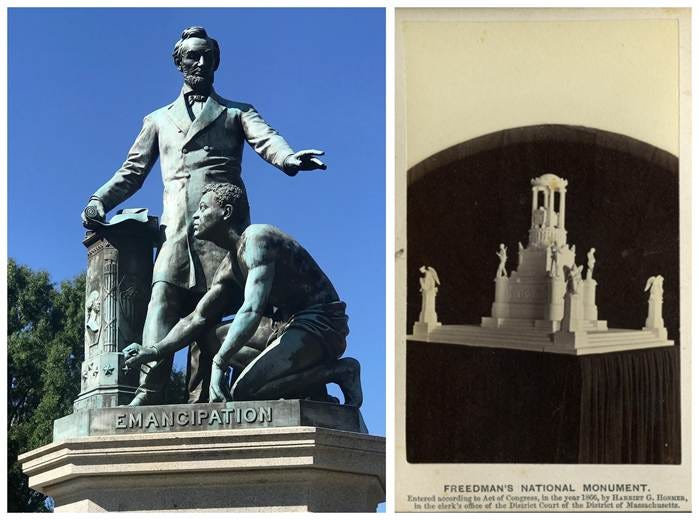
Left: Thomas Ball, Freedmen’s Memorial, Lincoln Park, 1876. Right: Harriet Hosmer’s 1866 design for the Freedman’s National Monument, rejected by the Western Sanitary Commission as too expensive.
So I stood there last summer knowing all of this. I had Hosmer’s drawings in my head. I had Douglass’s 1876 oration in my head, the one with the “preeminently the white man’s President” passage that the standard story has scrubbed nearly out of memory. I had Douglass’s separately rediscovered letter on monuments in my head: “no one monument could be made to tell the whole truth,” he wrote, and “what I want to see before I die is a monument representing the negro, not couchant on his knees like a four-footed animal, but erect on his feet like a man.” That was 1876. He was standing about where I was standing. He was telling us.
The thing he was telling us had already been refused once.
The standard story does not carry that refusal. The canonical image of the Freedmen’s Memorial is the kneeling figure; the canonical reading is gratitude. Douglass’s critique, when it survives in textbook treatment at all, is reduced to a quibble: Douglass had reservations. The 1876 oration’s third movement, which says Lincoln “was preeminently the white man’s President” and tells the freed people gathered for the dedication that “you are the children of Abraham Lincoln. We are at best only his step-children,” is almost never quoted in full. The rediscovered letter on monuments existed in the Library of Congress for over a century before historians flagged it for public attention.
We have not been short on the witness. We have been short on the listening.
What I had been thinking about for years, that summer in Lincoln Park, was the scale of what the country had refused to listen to.
The Southern Poverty Law Center’s April 2025 Whose Heritage? report, the country’s most comprehensive count, lists more than 2,000 Confederate symbols still standing in American public space. Roughly 685 of those are freestanding Confederate monuments; the rest are schools and roads named for Confederates, plaques, military-base names, state holidays.
About 20% of the still-standing freestanding monuments were erected on courthouse lawns, the majority going up between 1900 and 1920. The same twenty years that saw the legal architecture of Jim Crow finalized, lynching peak, and the Plessy doctrine become the operating constitutional law of the postwar South. The soldier-on-the-courthouse-square form is itself a constitutional argument: this is who the law serves. The same period saw obelisks rise in Confederate cemeteries, the genuine memorial form, the form mourning takes when it is mourning.
The split is the argument. Courthouses got soldiers. Cemeteries got obelisks. The country was being told what to remember and where to remember it.
The construction came in two spikes. The first ran 1900 through the early 1920s. The United Daughters of the Confederacy, founded 1894, reached roughly 100,000 members by World War I and worked at the pace of an organized political project. The second spike came between 1955 and 1965, the years in which Brown v. Board was being implemented, the Civil Rights Act was being legislated, and the Voting Rights Act was being marched for. Confederate monuments went up in answer to Black civil rights, not in mourning of the Civil War.
Henderson and his coauthors documented the relation directly in the Proceedings of the National Academy of Sciences in 2021. Where the lynchings happened, the monuments went up. Same counties. Same scale. Across the postwar South. The monuments are not innocent memorials in proximity to a separate violence. They are part of the apparatus the violence built and protected.
The UDC’s reach was not local-heritage-organization scale. The U.S. Congress authorized the reburial of 267 Confederate soldiers at Arlington National Cemetery in 1900. The UDC obtained Secretary of War William Howard Taft’s permission for the Confederate Monument at Arlington in 1907 and raised the funds for it. The Commonwealth of Virginia has paid the state UDC division more than $1.6 million since 1996 for maintenance of Confederate graves. The Arlington monument finally came down in 2023, by act of Congress, in the 2021 Defense Authorization Act, the first defense bill passed after the murder of George Floyd.
It took an act of Congress to remove a Confederate monument from the country’s primary military cemetery. The monument had been there for 116 years.
The men who dedicated these monuments did not hide what they were doing.
Julian Carr, North Carolina industrialist, at the 1913 dedication of the Silent Sam statue at the University of North Carolina: “I horse-whipped a negro wench until her skirts hung in shreds, because upon the streets of this quiet village she had publicly insulted and maligned a Southern lady.” He told the story as illustration of what Confederate soldiers had fought to protect.
Senator John Sharp Williams of Mississippi, at the 1927 dedication of a federally funded Jefferson Davis statue: the Confederacy fought to preserve “the cause of White Racial Supremacy.” A sitting U.S. Senator, at a federally funded monument, naming the cause directly, in 1927.
These speeches are the primary documents that no canon-revision argument needs to debate. They are the documentary record. The monuments were built to celebrate what they said they were built to celebrate.
A reader inclined to file all of this under history we have moved past should sit with two pieces of data.
The first: YouGov’s June 2023 polling. 28% of Americans still identify states’ rights, not slavery, as the Civil War’s main cause. The figure runs 35% among Americans over sixty-five and 24% among those under thirty. The polling has moved. The youngest cohort holds the Lost Cause’s version less than their parents and grandparents do.
The second: more than two thousand Confederate symbols and roughly 685 freestanding monuments still standing in American public space.
The narrative has begun to shift. The infrastructure has not. The narrative will keep shifting only as fast as the infrastructure lets it. This pamphlet is about the infrastructure.
This is what I was thinking about in Lincoln Park last summer. The country is not short on Confederate monuments. It is not short on people who believe what those monuments were built to make them believe. What it is short on is monuments to the people who did the actual work of building the country its founding documents claim to be: short on the Reconstruction officeholders and the Wilmington dead; short on Tubman in marble, on Wells in marble, on Houston and Marshall in marble; short, most of all, on Douglass in the form Douglass himself called for in 1876:
Erect on his feet like a man.
A new national canon is built two ways at once: by reckoning with the existing canon and raising the figures who have been refused. Both halves are hard work, and together they are the act of constructing the country we have been claiming to be.
Part II — Mythology Is the Country
What does it mean to say that a canon is constructed? Not metaphorically. Built, like a building, by people whose work is documented and whose decisions left records.
Benedict Anderson made the foundational claim in 1983: nations are imagined communities. They are not natural facts about ethnicity or geography. They are constructions, sustained by shared narrative and print culture, that allow scattered people to conceive of themselves as members of a common project.
Before there was an American people, there were people in Massachusetts and Virginia and South Carolina who began reading the same newspapers and pamphlets, attending the same political festivals, and absorbing the same myths about who they were and what they were doing. The nation came into being when those people began to imagine themselves as one.
The imagining is not a frill on top of the nation. The imagining is the nation. Strip the imagining away and you have not the nation in raw form; you have territory.
Eric Hobsbawm extended the claim in the same year, in The Invention of Tradition: many of the customs and rituals that nations present as ancient are in fact recent inventions, fashioned to legitimize institutions whose authority would otherwise be exposed as new. The Scottish kilt is nineteenth-century. The British royal pageantry as currently performed dates to the late nineteenth century. The Pledge of Allegiance was written in 1892 for a magazine promotion; “under God” was added in 1954, during the Cold War, to distinguish American children from Soviet children.
The tradition is the construction. The construction is not a betrayal of the tradition; it is the tradition.
Pierre Nora went further in his three-decade project Lieux de Mémoire (Sites of Memory). The site itself (the monument, the cemetery, the holiday, the museum) does not merely commemorate. It constitutes the nation’s relationship to its past. There is no nation-with-its-history that the monument represents; there is the monument-and-the-ritual-around-it, and that is the history, in the only form the history concretely exists in the lives of the people who live with it.
Change the monument and you have not commemorated the same past differently. You have changed the past, as the past operates in the country’s present life.
This is the framework. Take it seriously and the question of who is in marble at the front of the Capitol is not a curatorial question. It is a question about what the country is.
The Lincoln Memorial is the cleanest example I know.
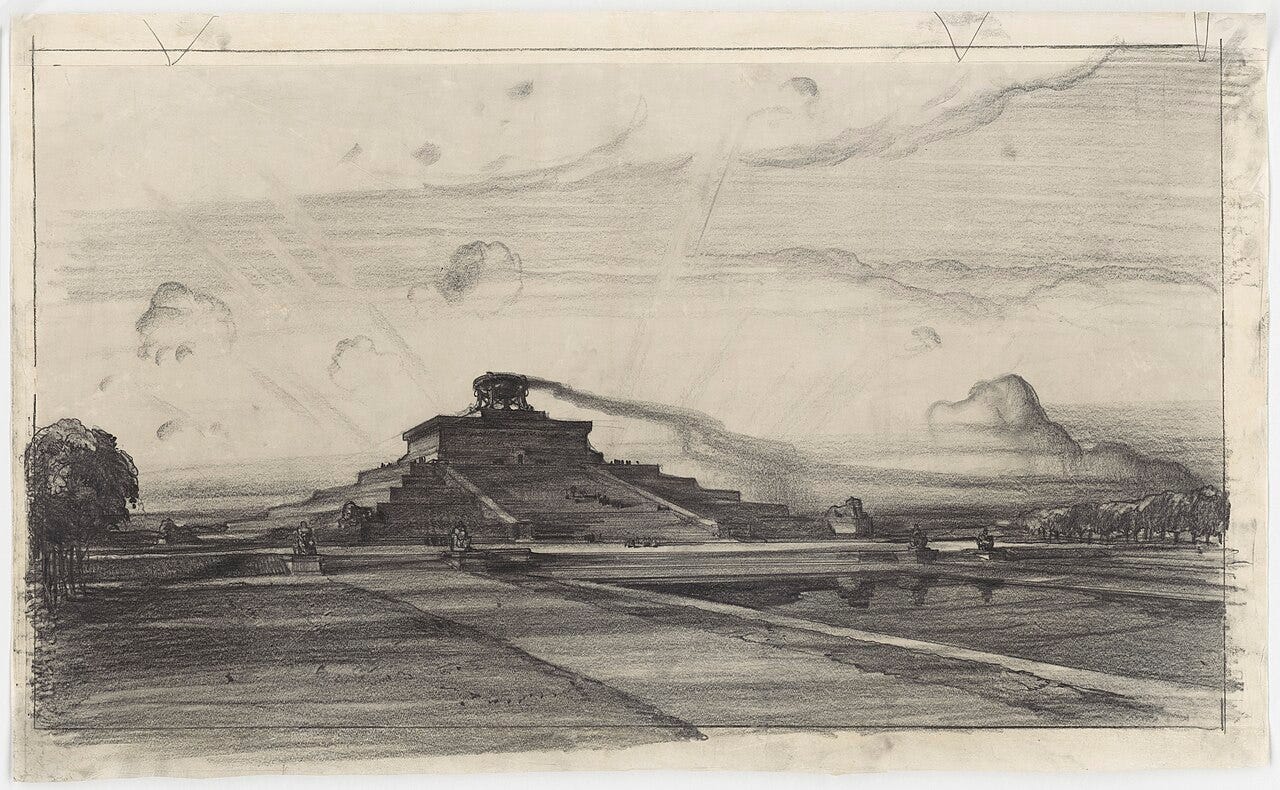
The Memorial was dedicated on May 30, 1922, Memorial Day. The holiday had been established in the 1860s to honor Union dead; the United Daughters of the Confederacy had successfully infiltrated it by the 1900s to honor Confederate dead alongside them in the same ceremonies. At the dedication, Black attendees were roped off in a separate section behind the white attendees. Robert Russa Moton, the principal of Tuskegee, had been invited to deliver an address. The text he submitted was revised by the dedication’s organizers. References to Black Americans as citizens with unfulfilled rights were excised. The version Moton delivered was the version that survived the editing.
The monument was inaugurated as a tribute to a Lincoln who had preserved the Union. It was not inaugurated as a tribute to a Lincoln who had freed the slaves. That second Lincoln did not yet exist in the official ceremony.
In April 1939, on Easter Sunday, the contralto Marian Anderson sang on the steps of the Memorial to a crowd of seventy-five thousand. The Daughters of the American Revolution had refused her permission to perform at Constitution Hall because she was Black. Eleanor Roosevelt resigned her DAR membership and arranged for the Lincoln Memorial steps to be made available. Anderson opened with My Country, ’Tis of Thee.
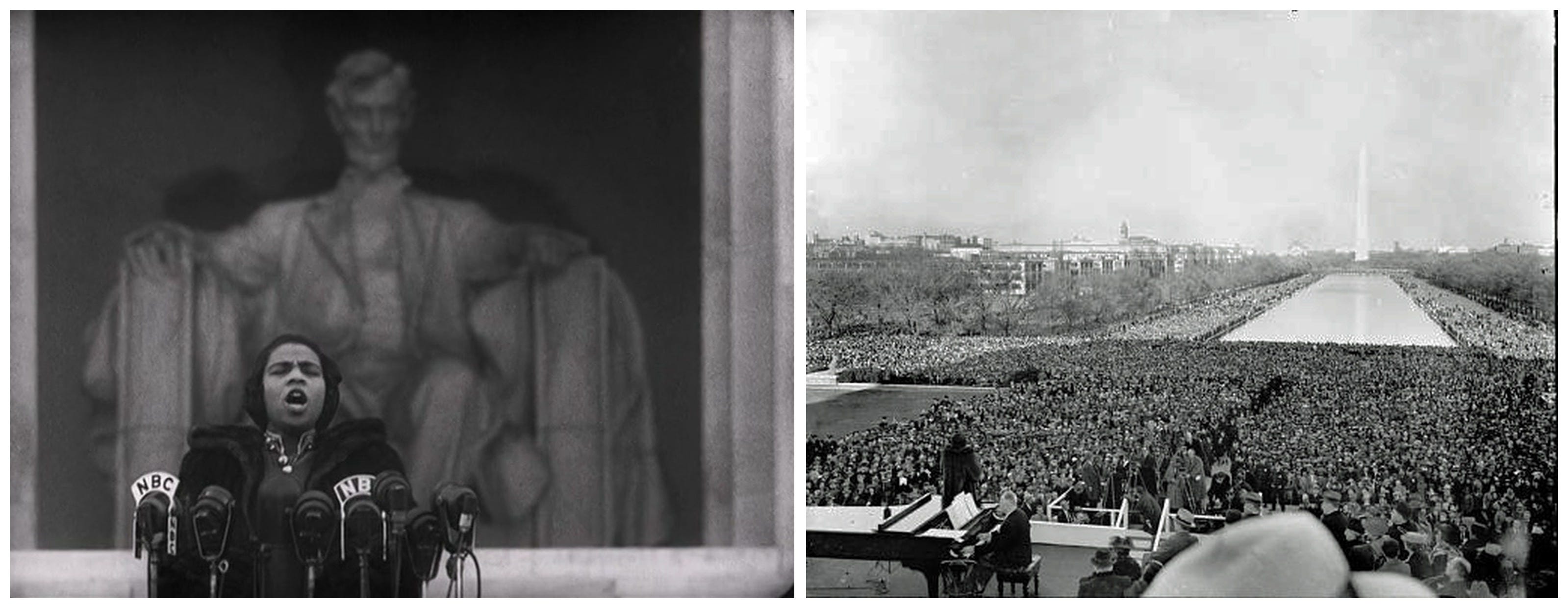
Marian Anderson singing on the steps of the Lincoln Memorial, Easter Sunday, April 9, 1939. Crowd of 75,000.
The monument was newly something it had not been seventeen years earlier: a stage on which Black Americans were claiming the country in front of it.
In August 1963, two hundred and fifty thousand people gathered at the same site for the March on Washington. Bayard Rustin organized the operation, working from a sixty-day execution timeline. Fifteen days before the march, he would be denounced on the Senate floor by Strom Thurmond as a homosexual and a former Communist. Martin Luther King Jr. delivered “I Have a Dream” from the steps.
The Memorial was, by the end of that day, a third thing: a monument not to a Union-preserving Lincoln, not to an integrationist concert site, but to a country whose Black citizens were claiming the founding documents as their own and reading them aloud in front of a marble Lincoln to a quarter-million-person witness.
Same monument. Three civic objects. The marble had not changed. The country had.
What the Lincoln Memorial illustrates, Nora’s framework names. The monument is not a record of the past. The monument is the past, in the country’s present moral and political life, and the country can change what its past means by changing what it does in front of, around, and instead of its monuments.
The Confederate-monument-removal campaign of the last decade is therefore not an attack on history. It is the operation of history. The 1922 Lincoln was constituted by what the country did and said at the dedication. The 1939 Lincoln was constituted by Marian Anderson. The 1963 Lincoln was constituted by Rustin and King. Each reading was as authoritative as the one before, because the reading is the past in the only sense the country uses the past at all.
David Waldstreicher’s In the Midst of Perpetual Fetes, published in 1997 and quietly canonical in American historiography ever since, makes the same point about the American founding moment that Anderson made generally. American nationalism was not the natural expression of a pre-existing American people. It was built, through Fourth of July parades, ratification celebrations, Washington’s-birthday observances, and the print culture that connected the local festivals into a national-scale imagined community.
Waldstreicher is precise about who the building was for: white society would not allow even symbolic Black participation in nationalism rituals. The imagined community was racialized at construction. The exclusion of Black Americans from the founding-moment civic ritual was not a residual prejudice that the imagined community contained. It was a constitutive feature. The American imagined community was, from the founding moment, a community of white Americans claiming the title American.
The Lost Cause is the same project run again, sixty years later, by different architects, for a different purpose.
The United Daughters of the Confederacy founded itself in 1894 with a clear program: control the textbooks, fund the monuments, write the dedication speeches, get the federal authorizations, defend the war as a noble cause and the Confederacy as a defense of states’ rights rather than of human enslavement. Mildred Rutherford published A Measuring Rod to Test Text Books in 1919, a pamphlet specifying which textbook treatments of the Civil War were acceptable for Southern schools and which were not. The Dunning School at Columbia, named for William Archibald Dunning, supplied the academic credentialing through the first half of the twentieth century: Reconstruction as failed experiment, Black officeholders as incompetent, the Klan as restorers of order. Birth of a Nation in 1915 and Gone with the Wind in 1939 carried the same story to mass audience.
In 1923, the UDC came closest to a federal-civic installation. Senator John Sharp Williams of Mississippi, the same Williams who would dedicate the Jefferson Davis statue four years later, introduced UDC-backed legislation authorizing a monument to “faithful slave mammies” in the District of Columbia. The Senate passed it. Organized Black opposition, led by Mary Church Terrell, blocked it in the House.
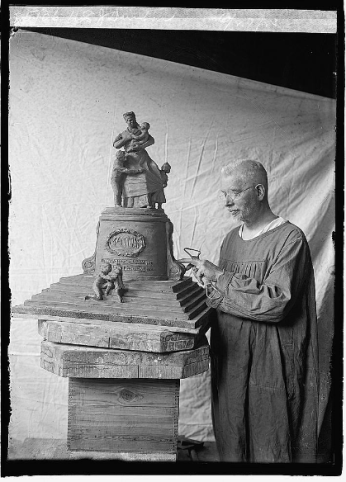
The construction was deliberate, named, funded, and operationally successful. The two thousand Confederate symbols still standing in American public space are what it built and what it is still operating through.
It is worth naming the constitutional version of the same project.
Originalism, as a methodological doctrine of constitutional interpretation, claims to recover the original meaning of the founders’ words. The claim is that the past is fixed and the present interpretation must defer to it. But originalism does not recover the past. It constructs the past it then defers to. The original meaning at any contested point is itself the product of historical selection, scholarly framing, and present-day political pressure.
Originalism does the same work the Lost Cause does. Both narrate the past as fixed in order to control the present. Both have architects, institutional apparatus, federal subsidies, and operational success.
What civic mythology is, then, is not infrastructure that supports the country. It is the country, in the only form the country exists in the lives of the people who live in it. Build a different canon and you have built a different country. Refuse to build it and you have left the country what the existing canon has made it.
There is no neutral middle here. There is no civic life lived outside the constitutive question.
Part III — Frederick Douglass, Founder
Frederick Douglass should be on the Founders’ tier of the American canon.
The claim sounds extravagant only to readers who have inherited the version of Founder that the existing canon teaches. Founder in standard American memory is a small set of white men from a thirteen-year window in the late eighteenth century who wrote the documents and stood up the institutions. By those criteria Douglass is excluded.
By the criteria the existing canon claims to honor (written and spoken articulation of what the country’s founding documents could mean; sustained political work to make those documents operational against organized resistance; documented influence on the legislative and constitutional history that turned the founding’s aspirations into law), Douglass belongs at a level no member of the existing Founders’ tier reached in the years they share with him.
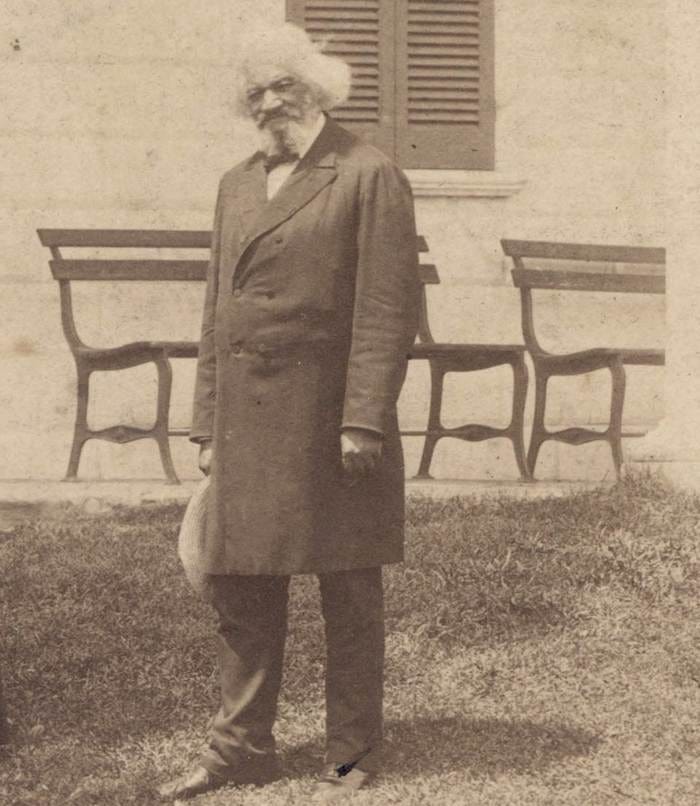
He was born enslaved in Maryland around 1818. He escaped in 1838. By the early 1840s he was a lecturer for the American Anti-Slavery Society; by 1845 he had published Narrative of the Life of Frederick Douglass, an American Slave, which is the Douglass the country reads in high school and almost never beyond. The Douglass who matters most for the canon question is the post-1851 Douglass, who broke with William Lloyd Garrison’s reading of the Constitution as a pro-slavery document and developed, instead, the antislavery-constitutional reading that would become the operational legal theory of the Civil War amendments.
The 1845 Narrative is the Douglass who was enslaved and freed. The post-1851 Douglass is the Douglass who built the Constitution he later helped rewrite.
On July 5, 1852, in Rochester, New York, Douglass delivered the speech that posterity has named “What to the Slave Is the Fourth of July?” Douglass himself titled it simply “Oration.” The speech is structurally a constitutional argument.
Its first movement praises the founders, names them as men who had labored under their own historical limits, and identifies in their work a foundation that subsequent generations would have to build upon.
Its second movement (the famous one, the one anthologized and excerpted and read aloud at commemorations) is the denunciation: “What, to the American slave, is your 4th of July? I answer; a day that reveals to him, more than all other days in the year, the gross injustice and cruelty to which he is the constant victim. To him, your celebration is a sham; your boasted liberty, an unholy license; your national greatness, swelling vanity…”
The denunciation is genuinely devastating, and it is what the standard memory carries. It is also the middle movement, not the close.
Douglass’s third movement is the argument that the Constitution, correctly read, is not the pro-slavery document Garrison had claimed it was. It is, in Douglass’s phrasing, “a GLORIOUS LIBERTY DOCUMENT.” He took the Constitution’s silences about slavery as openings rather than concessions. He read the Preamble’s “We the People” without the exclusion the Garrisonians wrote in. He read the Fifth Amendment’s due process clause as applying to all persons under the document, slave-state law notwithstanding.
The 1852 speech ends not on indictment but on the working materials of the constitutional case he would continue to refine through the 1850s, deliver in Glasgow in 1860, and watch enacted in the war amendments after 1865.
The denunciation is the speech’s most-quoted passage. The constitutional argument is its load-bearing one. The country has remembered the part it found rhetorically useful and forgotten the part on which the entire post-Civil-War legal order was built.
The full constitutional case Douglass delivered in Glasgow, Scotland, on March 26, 1860, eight months before South Carolina’s secession, is the most rigorous antislavery constitutional argument made before the war.
The address (The Constitution of the United States: Is It Pro-Slavery or Anti-Slavery?) is over twelve thousand words. It engages directly with the Garrisonian reading, the Calhounian reading, and the Taney Court’s Dred Scott reading. It parses the actual text of the Constitution clause by clause. Douglass arrives at his conclusion through argument, not assertion: the Constitution, as written, contains within it the legal materials for the abolition of slavery.
The war that would begin within twelve months would deliver the political conditions to use those materials. The Thirteenth Amendment in 1865, the Fourteenth in 1868, and the Fifteenth in 1870 are the operational form of the argument Douglass made in Glasgow.
He had not been alone in making the case (Lysander Spooner had argued for the antislavery Constitution in 1845; Salmon P. Chase had argued it in court before he became Lincoln’s Treasury Secretary and then Chief Justice), but Douglass made it most influentially, before the largest public audiences, with the personal authority of having been the legal property the document had been used to define.
Douglass met with Abraham Lincoln three times between 1863 and 1865.
The first meeting, in August 1863, concerned the Union Army’s treatment of Black soldiers: pay, promotion, prisoner-of-war status. Douglass had been recruiting for the 54th Massachusetts and the 55th Massachusetts regiments; his own sons served. He pressed Lincoln, in the meeting, for equal treatment of Black troops. He did not get everything he asked for. He did get a President who listened, and who, in subsequent months, moved the policy.
The second meeting, in August 1864, was about the post-war future of the freed people: what would happen, in particular, if Lincoln lost the November election. Lincoln asked Douglass to help organize an effort to bring as many enslaved people as possible behind Union lines before a potential Democratic administration negotiated a peace that would return them. The election Lincoln won made the contingency moot.
The third meeting, in March 1865, came after the second inaugural address. Lincoln saw Douglass in the receiving line and called him forward. Douglass reported that Lincoln told him, “There is no man’s opinion that I value more than yours.”
Six weeks later, Lincoln was dead.
These meetings are not background to Douglass’s career. They are central to it. The Lincoln who emerged in 1864 and 1865 (the Lincoln of the second inaugural, of the meetings about Black soldiers, of the late-war push toward the Thirteenth Amendment) was a Lincoln shaped, in part, by the political work Douglass had done in the public and private channels that brought him into the President’s office.
Standard Douglass treatment in K-12 curricula presents the 1845 Narrative and stops. The Douglass who was a working political actor at the highest level of the war presidency, the Douglass who shaped the legal architecture that the war made constitutional, does not appear.
Eric Foner’s The Second Founding (2019) makes the historiographical case directly: the Reconstruction Amendments are not amendments in the conventional sense of additions to an existing document. They are the operational form of a second founding, of which Douglass is the indispensable public theorist.
The Fourteenth Amendment’s due process and equal protection clauses are the legal-operational form of the constitutional argument Douglass had been delivering for fifteen years. Without Douglass, without the persistent public articulation that the Constitution as written contained the materials for abolition, citizenship, and equal protection, the political space for the amendments to be drafted and ratified does not exist.
Foner is careful. He does not claim that Douglass wrote the amendments; the amendments had multiple architects, including Thaddeus Stevens, Charles Sumner, and the Joint Committee on Reconstruction. He claims that Douglass made the public case on which the architects could build.
That is the work of a Founder.
If the case stopped there, it would already be sufficient. It does not stop there.
On April 14, 1876, Douglass delivered the dedication oration at the unveiling of the Freedmen’s Memorial in Lincoln Park. The oration is the most morally clear-eyed assessment of Lincoln any contemporary delivered.
Douglass praises Lincoln. He also names what Lincoln was. “He was preeminently the white man’s President, entirely devoted to the welfare of white men. He was ready and willing at any time during the first years of his administration to deny, postpone, and sacrifice the rights of humanity in the colored people, to promote the welfare of the white people of this country.”
A few minutes later in the same speech: “Viewed from the genuine abolition ground, Mr. Lincoln seemed tardy, cold, dull, and indifferent; but measuring him by the sentiment of his country, a sentiment he was bound as a statesman to consult, he was swift, zealous, radical, and determined.”
The Douglass who delivered that oration was fifty-eight years old. He had been free for thirty-eight years. He had personally pressed the President whose memory was being dedicated. He had been told, by that President, that there was no man’s opinion he valued more.
He was not the kneeling figure on the statue behind him.
He was the figure who, in the same year, called in writing for a monument that represented the negro “erect on his feet like a man.” That is what the standard textbook treatment of Douglass scrubs. The Douglass who could praise Lincoln and indict Lincoln in adjacent paragraphs of the same speech, who could note the country’s debt to the President and the President’s failures to that country’s Black citizens without softening either, who could see the marble at his back and declare in the same year that a different monument was needed. That Douglass is one of the most morally clear-sighted political voices in American history.
There is no contemporary white American who reached his level of clear sight, in the available record, on the question the war was fought over.
Thurgood Marshall delivered the 1987 Bicentennial Address (The Constitution’s Bicentennial: Commemorating the Wrong Document?) at a moment when the federal government was scheduled to celebrate two hundred years of the founding. Marshall refused to celebrate.
The document the country was honoring, he said, was not the document the country actually lived under in 1987. The 1787 Constitution had been written by men who, having declared all men created equal, had counted enslaved Black people as three-fifths of a person for the purposes of allocating their owners’ political power. That Constitution had needed a civil war, three amendments, and a century of legal struggle to become anything like a charter the country could honor.
The Constitution Marshall would celebrate, when he was prepared to celebrate it, was the post-Civil-War Constitution. The argument is Douglass’s argument, translated forward 111 years and placed before the first Black Supreme Court Justice’s hand. The Bicentennial Address is the 20th-century operationalization of the Glasgow speech.
Marshall does not quote Douglass directly in the text we have. The intellectual genealogy is structural, not citational. It runs anyway.
The final piece of the Founder case is the one most likely to surprise readers who hold the canonical version of nineteenth-century reform alliances.
In 1869, the proposed Fifteenth Amendment, which would extend the franchise to Black men but not to women, split the American Equal Rights Association, the multiracial suffrage coalition Douglass had helped build. Elizabeth Cady Stanton and Susan B. Anthony argued against the amendment unless women were included in its protections.
They argued in terms that named what the terms were. Stanton, in a January 1869 article for The Revolution: “Patrick and Sambo and Hans and Yung Tung, who do not know the difference between a monarchy and a republic, who can not read the Declaration of Independence or Webster’s spelling-book, making laws for Lucretia Mott.”
Sambo. The deliberate racialization of the argument was not subtext. It was text. Anthony, in the same period, refused to campaign for Black male suffrage on the grounds that women’s enfranchisement must come first. The AERA coalition, which Douglass had built in 1866 to advance Black and women’s suffrage together, collapsed inside three years.
Douglass argued back. When women, he said, were dragged from their homes and lynched, when their children were torn from their arms, when their houses were burned down over their heads because of who they were, when the bodily terror Black Americans were facing in 1869 was also the daily condition of American women, then their case for the franchise would have the same urgency as his. Until then, the proposition that white women’s exclusion from the franchise was a greater injury than Black Americans’ exposure to organized terror was not a complexity. It was a position. He argued against the position. He chose the Fifteenth Amendment.
The standard treatment of this episode in feminist canonical memory has been to call it “complexity.” It was not complexity. It was Stanton and Anthony’s racism, deployed against a coalition Douglass had been instrumental in building, in service of a position that prioritized the political enfranchisement of white women over the physical survival of Black Americans.
Naming this plainly is not an attack on Stanton or Anthony’s other achievements. Both women belong in the suffrage canon, and both did real work. It is, however, the discipline that lets the figures of the second founding be honored without smoothing what they had to step through to do their work.
Douglass chose. He chose right. The country has not yet honored the choice.
He died on February 20, 1895, fifty-six years before Brown v. Board. The Constitution he had argued for was, in legal-operational form, the Constitution the country lives under now. The monuments he called for, in 1876, do not yet exist at the scale the documentary record warrants.
He is the canonical figure the existing American canon has most consequentially refused. Founder. The documentary record has been waiting since 1876.
Part IV — The Long American Second Founding
Douglass died on February 20, 1895. The institutional destruction of the second founding he had argued into existence was already three decades underway.
The cohort of Black Americans who governed in the post-war South during Reconstruction were Founders by the same criteria that put Douglass on the Founders’ tier: sustained political work to make the founding documents operational against organized resistance, documented influence on the legislative history, public articulation of what the country’s Constitution could mean. They have been refused at scale.
The country has not given them a tier in the canon. Their names are not taught. The school system that puts the 1787 Convention delegates in front of every American child does not put them in front of any American child.
The numbers themselves are the first refusal.
Eric Foner’s Freedom’s Lawmakers: A Directory of Black Officeholders During Reconstruction (1993, revised 1996), the definitive scholarly source, documents roughly two thousand Black elective and appointive officeholders across the post-war South between 1865 and 1876. Foner profiles 1,510 of them in detail by name: legislators, state officials, sheriffs, justices of the peace, constables.
South Carolina: 315 Black officeholders, 210 in the lower house, a Black majority in that chamber through the early Reconstruction years. Mississippi: 154. Louisiana: 124 and counting. Alabama: 100 and counting, in the state legislature between 1868 and 1878.
This was not token representation. It was a functioning multiracial democracy at scale, operating across the geography that had two and three years earlier been the geography of the Confederacy.
The named figures who emerged from that cohort are figures of canonical stature in any honest accounting.
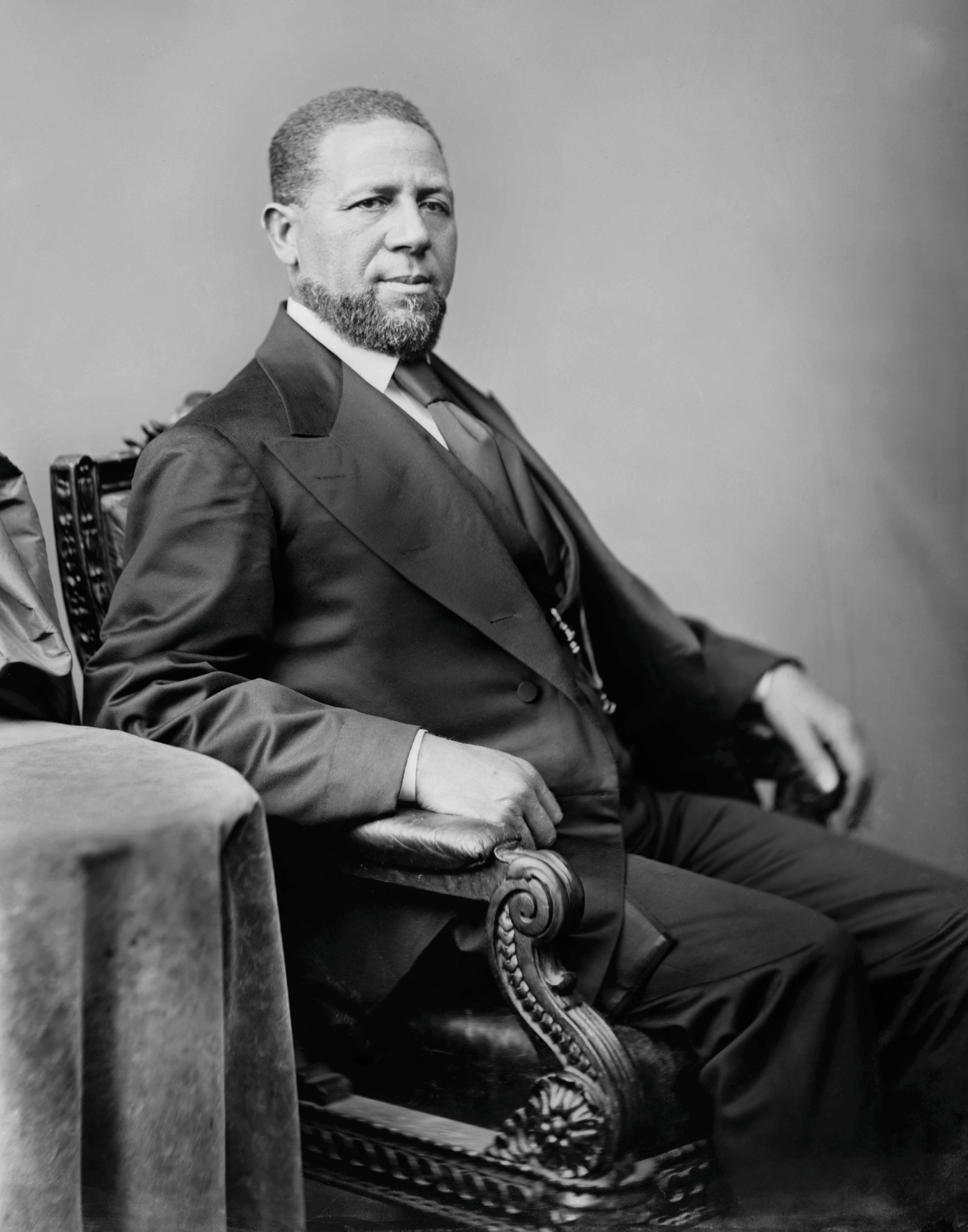
Hiram Revels, born in Fayetteville, North Carolina in 1827, became the first Black United States Senator in 1870, completing the term that had been held by Jefferson Davis before Davis withdrew to lead the Confederacy.
Blanche K. Bruce, a Mississippi Republican, served a full Senate term from 1875 to 1881. The first Black senator to serve a full term, and the only one until Edward Brooke a century later.
P. B. S. Pinchback became, for thirty-six days between December 1872 and January 1873, the first Black acting governor of an American state, in Louisiana.
Robert Brown Elliott, born in 1842, served in the U.S. House from South Carolina and on January 6, 1874, delivered a Civil Rights Bill floor speech that directly debated Alexander Stephens (the former Confederate Vice President, now a sitting member of the House) and won the room. The bill Elliott was arguing for, the Civil Rights Act of 1875, passed Congress and was signed into law.
John Roy Lynch, of Mississippi, served in the House from 1873 to 1883 and wrote, decades later, The Facts of Reconstruction (1913). The first major scholarly refutation of the Dunning School’s framing of Reconstruction, published twenty-two years before W.E.B. Du Bois’s Black Reconstruction in America (1935) and seventy-five years before Foner’s Reconstruction (1988).
George Henry White, of North Carolina, served in the House from 1897 to 1901 and was the last Black member of Congress from the South for seventy-two years.
These are not minor figures. These are the operational architects of the Reconstruction state: the men who ran the schools, drafted the legislation, prosecuted the cases, sat in the senates, and put the legal-operational form of the war amendments into practice. By the criteria the existing American canon claims to honor, every name above belongs in the canon.
The destruction of their work was not natural. It was organized.
The legal architecture began to collapse almost as quickly as it had been built.
The Supreme Court, in Slaughter-House (1873), narrowed the Fourteenth Amendment’s Privileges or Immunities Clause to a near-nullity. In United States v. Cruikshank (1876), it overturned the federal convictions of white men who had massacred Black Republican officeholders at Colfax, Louisiana, on Easter Sunday 1873, the largest single act of racial violence during Reconstruction. The Court ruled that the Fourteenth Amendment did not authorize federal prosecution of private racial violence.
In the Civil Rights Cases (1883), the Court struck down the Civil Rights Act of 1875, the bill Elliott had argued onto the floor, on the theory that Congress could not legislate against private discrimination. The decision was 8-1, with John Marshall Harlan in dissent. Douglass, still alive, denounced the ruling immediately.
The dissent’s reasoning would become law in 1964. The Civil Rights Act of 1964 is the legal-operational form of the Civil Rights Act of 1875, delayed by eighty-nine years.
Plessy v. Ferguson in 1896 finalized the architecture. Separate but equal. The country’s highest court had spent a quarter-century systematically dismantling the constitutional framework Douglass had argued for and the Black officeholders had built.
Foner’s framing in Reconstruction: America’s Unfinished Revolution (1988) is more careful than a simple “success that was destroyed.” Reconstruction, in Foner’s account, was a revolutionary attempt that achieved real institutional gains but was structurally undercapitalized, particularly because of the failure of land redistribution.
The Freedmen’s Bureau lacked the funding, the authority, and the political backing in Washington to transfer the land that would have given Black freedmen economic autonomy. “Forty Acres and a Mule” was issued as Special Field Order No. 15 by William Tecumseh Sherman in January 1865 and rescinded by Andrew Johnson before the year was out.
The Black political class that emerged in the South in the 1860s and 1870s did so without the economic foundation that would have made their political position structurally durable. When the violence came, they had the votes but not the land. The destruction was abetted by what the Reconstruction state had not been able to do, not only by what its enemies did to it.
What its enemies did to it is also documented. It was also a project.
The Ku Klux Klan formed in 1865 in Pulaski, Tennessee, and within five years was operating across the post-war South. Federal prosecution under the Enforcement Acts of 1870 and 1871 suppressed the first Klan; the network it had built reconstituted itself under different names. The White League in Louisiana attacked the state government in the Battle of Liberty Place in 1874. Several thousand armed white men occupied the New Orleans state house for three days before federal troops arrived. The Red Shirts in the Carolinas operated as the paramilitary arm of the state Democratic Party from the 1870s forward.
The 1875 Mississippi Plan (election violence and intimidation deployed at scale) restored Democratic control of that state’s government and became the template for the rest of the South.
By 1877, with the Hayes-Tilden compromise withdrawing the last federal troops, the Reconstruction state had been politically defeated. By 1898, with Wilmington, it could be operationally overthrown.
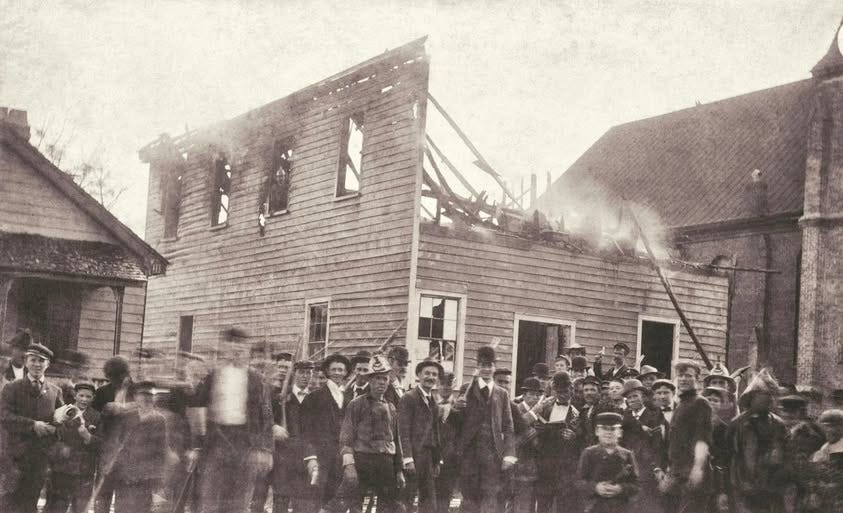
The Wilmington coup of November 10, 1898, is the cleanest documented instance of what was happening across the post-Reconstruction South. It is also the only successful overthrow of a duly elected U.S. municipal government in American history.
The coup was planned in March 1898, eight months in advance, in meetings convened by Josephus Daniels (then the publisher of the News and Observer in Raleigh; later Secretary of the Navy under Franklin Roosevelt), Furnifold Simmons (state Democratic Party chair; later a five-term U.S. Senator), and Charles Brantley Aycock (orator, later Governor of North Carolina, later honored with the statue North Carolina sent to U.S. Capitol Statuary Hall in the 1930s, finally removed and replaced by Billy Graham in 2024).
The operation was organized into three arms: “the Men Who Could Write,” “the Men Who Could Speak,” and “the Men Who Could Ride.” Newspapers, orators, paramilitary cavalry.
The pretext for the coup was an August 1898 editorial in Wilmington’s Black-owned Daily Record by Alex Manly, who was the newspaper’s editor and a Black Republican civic leader. Manly’s editorial pushed back on Rebecca Latimer Felton’s argument that white women in the South required lynching as a defense against Black men. Manly observed that interracial relationships were often consensual, that the rape narrative was being deployed to legitimate political violence, and that white men should be careful about preaching morals to Black men given their own treatment of Black women.
The editorial was widely reprinted by the white-supremacist press over the next three months as proof of the necessity of what was about to happen.
On November 9, 1898, white Wilmington produced the White Declaration of Independence, a published document, signed by hundreds of white men of the city, declaring that they would no longer be ruled by Black officials and that the elected Republican government would be overthrown. The Declaration was published and reprinted across the state.
It was not a secret plan. It was a public threat.
On November 10, the coup was carried out. White paramilitaries burned the Daily Record offices. They marched through the Black neighborhoods firing on residents. They killed an unknown number. The 2006 North Carolina commission report estimated as many as sixty. They forced the resignation of the elected mayor, the aldermen, and the police chief. They installed their own slate. About 2,100 Black residents were displaced from the city in the days and weeks that followed. Many were marched onto trains under armed guard and forbidden to return.
The federal government did not intervene. There were zero federal prosecutions. The Republican Party of North Carolina collapsed as a competitive force. North Carolina’s Black voter registration fell from approximately 126,000 in 1896 to fewer than 6,100 in 1902.
The named victims of the coup, recovered through the decades-long work of the Third Person Project and the descendants of those killed, are Joshua Halsey, Sam McFarland, Daniel Wright, William Mouzon, John L. Gregory, John L. Townsend, and Silas Brown (recorded in some sources as Charles Lindsey). The unnamed dead are honored at the 1898 Memorial Park in Wilmington, dedicated November 8, 2008, by a jar of soil labeled “unknown,” gathered alongside named-victim jars from the locations where each killing occurred.
The Wilmington 1898 Museum for Healing, Education, and Democracy was announced in November 2024 and is planned to open in spring 2028, the 130th anniversary of the coup.
That terminological shift (from “race riot” to “coup”) is itself a recent historical event.
From 1898 through approximately the year 2000, the standard American historiographical and textbook framing of the events of November 10, 1898, was “the Wilmington Race Riot.” That framing originated in the Lost Cause press of the coup’s own architects and was retained, with minor variations, in mainstream U.S. history textbooks for a century.
The shift in framing (to “coup,” “massacre,” or “insurrection”) was driven by the May 2006 release of the 1898 Wilmington Race Riot Commission Report, commissioned by the North Carolina General Assembly; by the publication of David Zucchino’s Wilmington’s Lie: The Murderous Coup of 1898 and the Rise of White Supremacy (Atlantic Monthly Press, 2020), which won the Pulitzer Prize for General Nonfiction in 2021; and by the 2024 PBS American Experience documentary American Coup: Wilmington 1898.
The reframing is post-2000. It is current. It is an instance of the mythological-correction work this pamphlet is calling for, operating on the timescale it actually operates on: a century of suppression, two decades of correction, three more decades before the museum opens.
George Henry White, the last Black congressman from any Southern state until 1973, delivered his farewell address to the House of Representatives on January 29, 1901. White had been driven out of office by the same white-supremacist coalition that had carried out the Wilmington coup three years earlier. The suppression operated across North Carolina at the same scale it had at Wilmington, just more slowly.
His farewell speech: “This, Mr. Chairman, is perhaps the negroes’ temporary farewell to the American Congress; but let me say, Phoenix-like he will rise up some day and come again. These parting words are in behalf of an outraged, heart-broken, bruised, and bleeding, but God-fearing people, faithful, industrious, loyal people — rising people, full of potential force.”
The Phoenix did not rise for seventy-two years.
The next Black member of the U.S. House from the post-Confederacy South was Andrew Young, of Georgia, elected in 1972. The next Black member of the U.S. House from North Carolina specifically was Eva Clayton, elected in 1992, ninety-one years after White’s farewell.
The country had had Black officeholders at full congressional scale in the 1870s. It would not have them again from the same geography for three generations.
On November 6, 2021, Joshua Halsey received a proper funeral in Wilmington, North Carolina, 123 years after his murder by the white paramilitaries who took the city on November 10, 1898. His descendants (generations of them, working with the Third Person Project’s researchers) had identified him by name. They located the approximate site of his death. They gathered soil. They brought him into a service of mourning that the city had refused to give him at the time.
The funeral was covered by CNN, ABC, NPR, and local outlets. Members of his family spoke. Soil from the killing site was laid in a vessel on the altar.
That same fall, on September 8, 2021, the equestrian Robert E. Lee statue on Monument Avenue in Richmond, Virginia, had come down, after court challenges that ran back to August 2020 finally ended in the state Supreme Court’s ruling that the removal could proceed. The bronze that had been raised in 1890 was cut into sections in front of a crowd that included direct descendants of enslaved Virginians and was placed in storage pending eventual exhibit. The pedestal, covered for two years in protest graffiti (Black Lives Matter, the names of Floyd and Breonna Taylor and Ahmaud Arbery), was removed in December.
Across the same months, the John R. Lewis Voting Rights Advancement Act was filibustered in the United States Senate. The bill, named for the man whose skull had been fractured on the Edmund Pettus Bridge in 1965 (a bridge named for an Alabama Confederate brigadier and Klan leader, and which has not been renamed), would have restored the federal preclearance regime that the Supreme Court gutted in Shelby County v. Holder (2013). It would have made what happened in Wilmington in 1898, and what happened across the South in the seventy years after, structurally harder to do again.
The Senate did not pass it. It has been reintroduced in 2022, 2023, 2024, and 2025, and has been filibustered every time.
The simultaneity of those three events (Halsey’s funeral, Lee’s removal, the Lewis Act’s filibuster) was not coincidental. They are continuous instances of the same project, moving forward against organized resistance, at the speed mythological correction operates when it operates at all.
The man who was killed in the long American second founding’s overthrow received his funeral in the same season that the bronze celebrating the overthrow came down and the legislation that would have prevented its recurrence was killed in the Senate by the descendants of the politics that produced both.
The work is current. The work is unfinished. The work is also, in the historical record’s slowest tense, real.
That is the long American second founding. That is what the country has refused to canonize. That is what it would mean to canonize it now.
Part V — The Canon We Have Earned
The destroyers of the second founding had names. The builders had names too.
Some of those names extend into the long century after Reconstruction, figures who carried the second founding’s argument forward when the institutional second founding had been overthrown. Each belongs in the canon. Together they constitute the canon the country has earned.
Criteria first.
What makes someone a Founder by the existing American canon’s own standards? The framers of 1787 are honored for: operational impact on the country’s emergence (the political and military work that made the Republic exist as a fact); legal architecture (the documents and the institutions that operate the Republic); prophetic articulation (the case, in public, for what the Republic could and should be); organizational leadership (the conventions, the campaigns, the federal agencies that built the operational state); moral courage at scale (lives, freedoms, and political careers staked on positions whose success was not assured).
By all five criteria, the framers belong in the canon. By all five criteria, so do the figures the existing canon has refused.
Tubman.
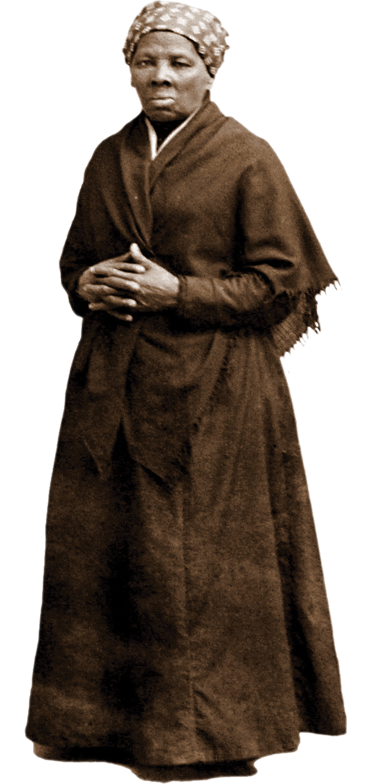
Harriet Tubman was born around 1822 in Dorchester County, Maryland, enslaved. She escaped in 1849.
Over the next eleven years, by the corrected numbers in Kate Clifford Larson’s Bound for the Promised Land: Harriet Tubman, Portrait of an American Hero (2004), the canonical modern Tubman biography, she personally led approximately seventy enslaved people from Maryland to freedom across thirteen trips back into slave territory, and gave instructions to roughly seventy more who reached freedom on their own through her network.
The popular figure of “300 across 19 trips” originates with Sarah H. Bradford’s 1868 fundraising biography and is an exaggeration. The Larson numbers are smaller and more astonishing: thirteen self-organized infiltrations of the enforcement geography of American slavery, by a single Black woman, with no recorded loss of anyone she personally led.
She was never caught. The people she led were never recaptured.
The Underground Railroad was a distributed operation with many operators; Tubman was the operator whose record is the best documented in the literature.
Then she became a military officer.
On June 2, 1863, Tubman planned and led the Combahee River Raid in the South Carolina low country, in coordination with the Second South Carolina Volunteers, a Black Union regiment under Colonel James Montgomery. The raid burned plantations along the Combahee, destroyed Confederate supply infrastructure, and liberated approximately 750 enslaved people in a single operation, the largest single liberation of enslaved Americans during the Civil War.
Tubman was the first American woman to plan and lead a major military operation. She was forty-one.
Forty-two years later, in 1899, the federal government issued her a widow’s pension of $20 per month (her late husband had served in the war) rather than the soldier’s pension that her own service would have warranted. The federal government denied her own military service its formal recognition.
She died in 1913.
Her face was scheduled to replace Andrew Jackson on the $20 bill by 2020. The replacement has been delayed indefinitely. YouGov polling from 2022 shows 43% public support for putting Tubman on currency against 31% for Jackson, a twelve-point gap in Tubman’s favor, with Jackson being the figure being replaced. The political resistance to issuing the Tubman $20 is not coming from majority public opposition.
Operational impact at scale. The military-and-political criterion the existing canon claims to honor. By that criterion, Tubman is a Founder.
Wells.
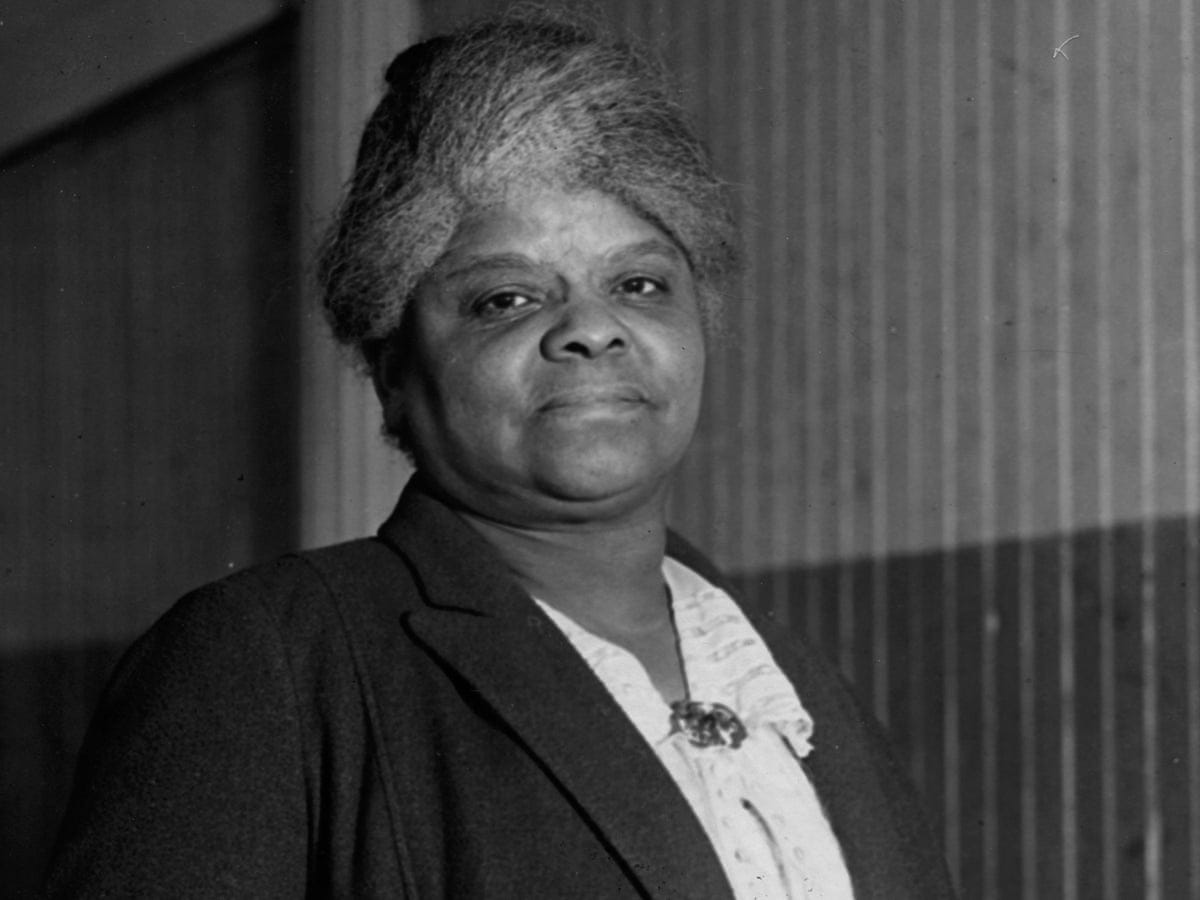
Ida B. Wells was born in 1862 in Holly Springs, Mississippi, enslaved. After three friends (Thomas Moss, Calvin McDowell, and Henry Stewart) were lynched in Memphis in 1892 for the offense of running a grocery store that competed successfully with white merchants, Wells began the empirical research that became Southern Horrors: Lynch Law in All Its Phases (1892) and A Red Record (1895), the two foundational works of American anti-lynching journalism.
Wells’s method was investigative. She counted lynchings. She read the white press’s stated justifications and cross-checked them against court records, eyewitness accounts, and Black community testimony.
Her finding was that the “rape” pretext deployed to legitimate lynching was, in the documented cases, almost entirely fabricated; the actual pattern was the targeting of economically successful Black Americans, of Black men engaged in consensual relationships with white women, and of any Black American whose existence offered political resistance to white-supremacist municipal control.
The Wilmington 1898 Manly editorial was making, in compressed form, the case Wells had documented over the preceding six years.
She kept making it. She traveled to Britain in 1893 and 1894 to build international anti-lynching pressure. She helped found the NAACP in 1909. She campaigned for suffrage. She refused, at the 1913 Washington suffrage march, to be relegated to the back of the line with the other Black suffragists; she walked with the Illinois delegation.
She lived her professional life under death threats and produced the empirical research that the federal anti-lynching law of 2022 was finally legislated on top of. The Emmett Till Antilynching Act was signed by President Biden on March 29, 2022.
Wells had begun the empirical case for federal anti-lynching legislation in 1892. The gap from her work to the legislation she had argued for was 130 years.
Prophetic articulation with empirical method. The investigative-journalism criterion the existing canon claims to honor when it honors Edward R. Murrow or I. F. Stone. By that criterion, Wells is a Founder.
Houston and Marshall.
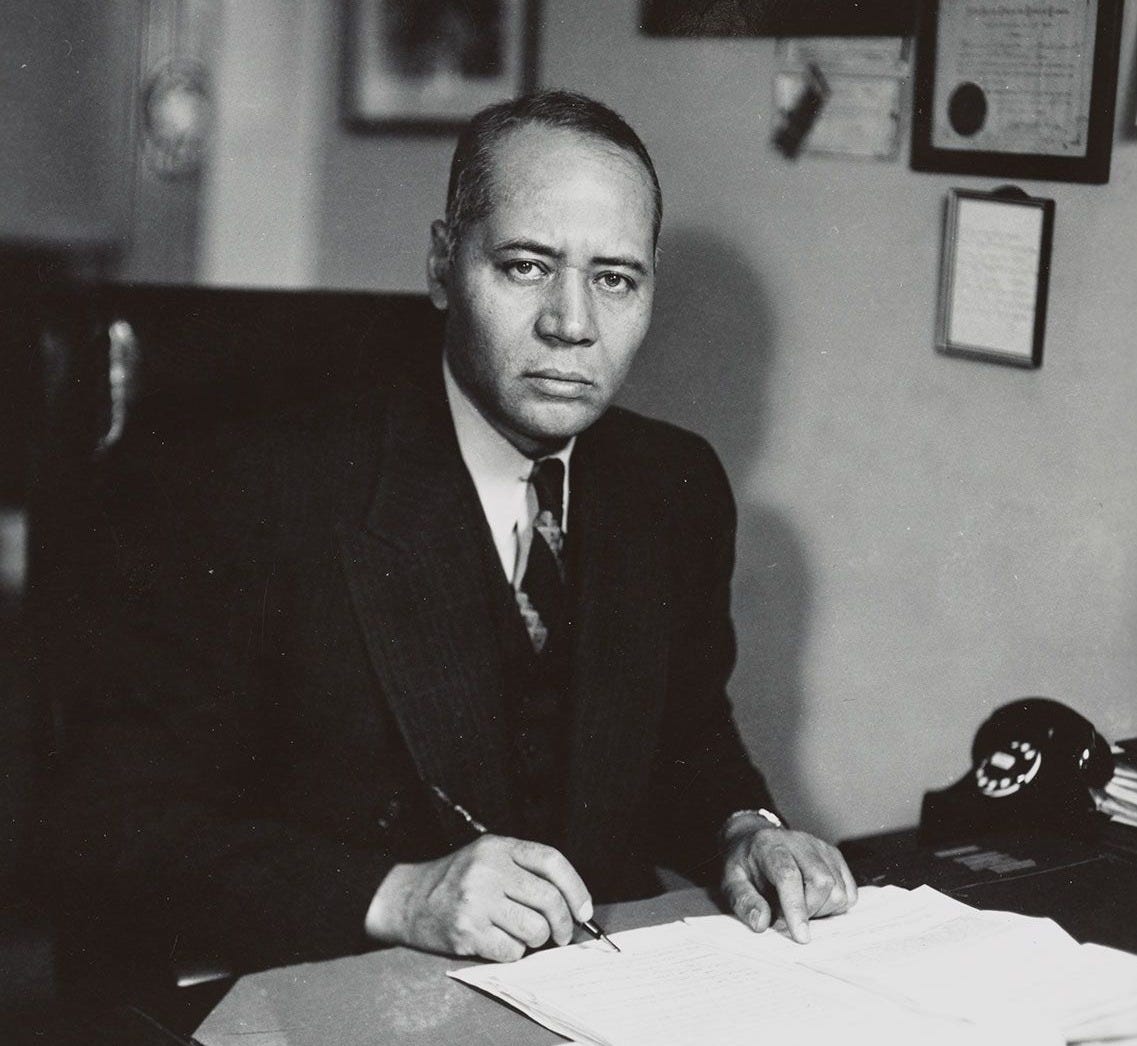
Charles Hamilton Houston, born in 1895 and dean of Howard Law School from 1929, was the architect of the legal strategy that turned the Fourteenth Amendment into operational law in the courts. His method was to attack the legal infrastructure of segregation by demonstrating, case by case, that “separate but equal” was operationally impossible to deliver in actual practice. The strategy required patience over decades, federal court litigation in unfriendly jurisdictions, and a generation of trained Black lawyers willing to litigate civil rights cases in the segregated South. Houston trained that generation at Howard Law.
He was the man, in his student Thurgood Marshall’s later phrase, who killed Jim Crow.
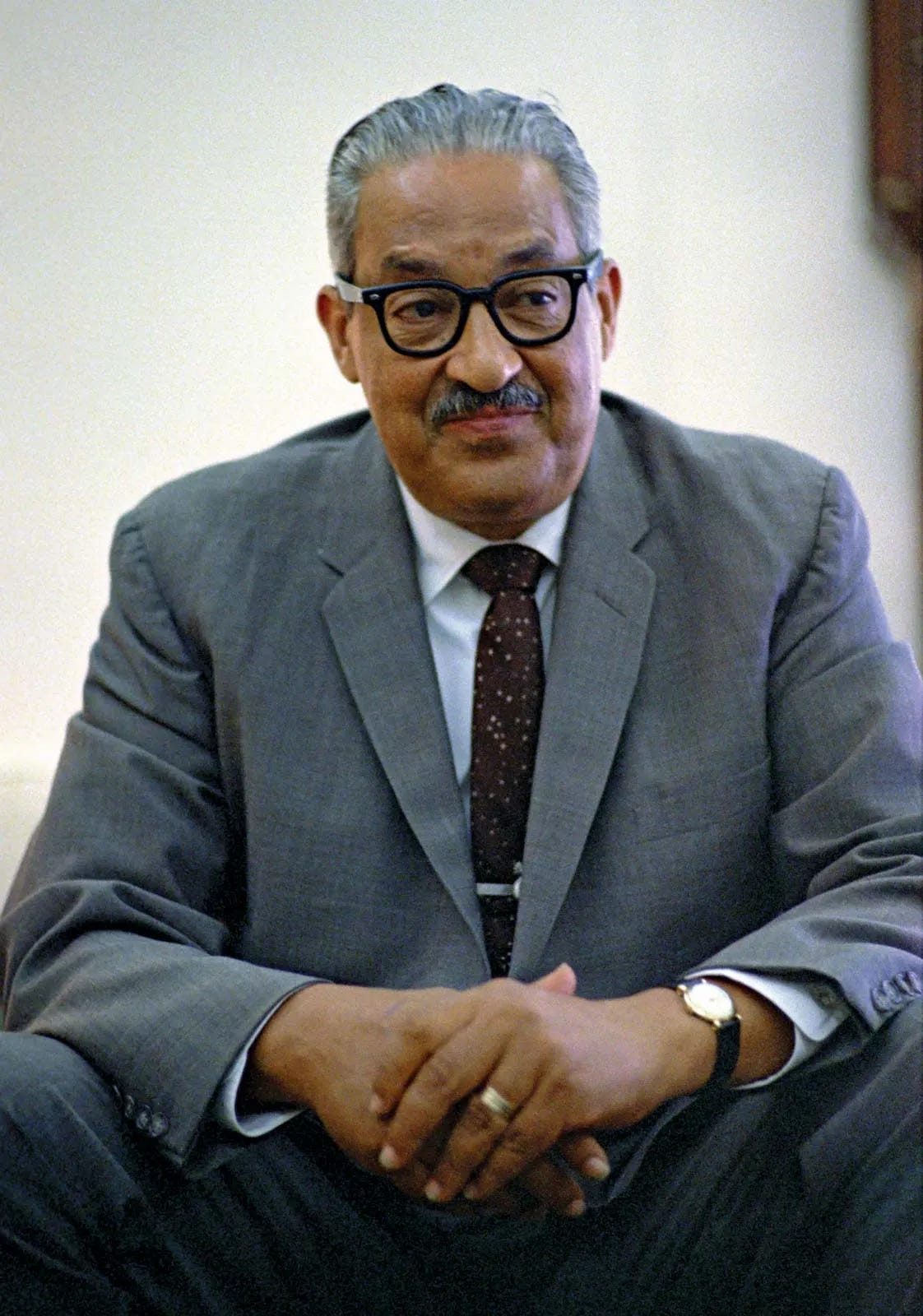
Thurgood Marshall was Houston’s student. He had been rejected by the University of Maryland Law School in 1930 because of his race. In 1933 he graduated from Howard Law, first in his class, with Houston as his dean and direct mentor. In 1934 he opened a private practice in Baltimore. In 1935, five years after the rejection, he and Houston took the case of Donald Gaines Murray, a Black applicant who had been rejected by the same Maryland Law School that had rejected Marshall.
On January 15, 1936, the Maryland Court of Appeals ruled unanimously for Murray. Maryland was ordered to admit him.
The segregated law school that had refused to admit Thurgood Marshall five years earlier was integrated by the man it had refused, arguing alongside the mentor whose strategy was now operational.
Murray v. Pearson (1936) was the first successful test of the Houston-Marshall strategy. Missouri ex rel. Gaines v. Canada (1938) extended it. Sweatt v. Painter (1950) and McLaurin v. Oklahoma State Regents (1950) extended it again. Brown v. Board of Education (1954) finished the line.
The strategic arc from Murray to Brown was eighteen years. Houston died in 1950, four years before Brown, of a heart attack at fifty-four, after two decades of work that the modern legal profession has not produced a comparable instance of.
Marshall served on the Second Circuit from 1961 to 1965 and as Solicitor General from 1965 to 1967. He was confirmed to the Supreme Court on August 30, 1967, the first Black Justice in the Court’s history. He served until June 27, 1991. He delivered the 1987 Bicentennial Address, the address that argued the country was celebrating the wrong document, and that the post-Civil-War Constitution was the one any honest reader of the legal-historical record would honor. He died on January 24, 1993.
Legal architecture sustained across a half-century. The constitutional-litigation criterion the existing canon claims to honor when it honors John Marshall the Chief Justice or Felix Frankfurter or William Brennan. By that criterion, Houston and Marshall are Founders.
Hamer.
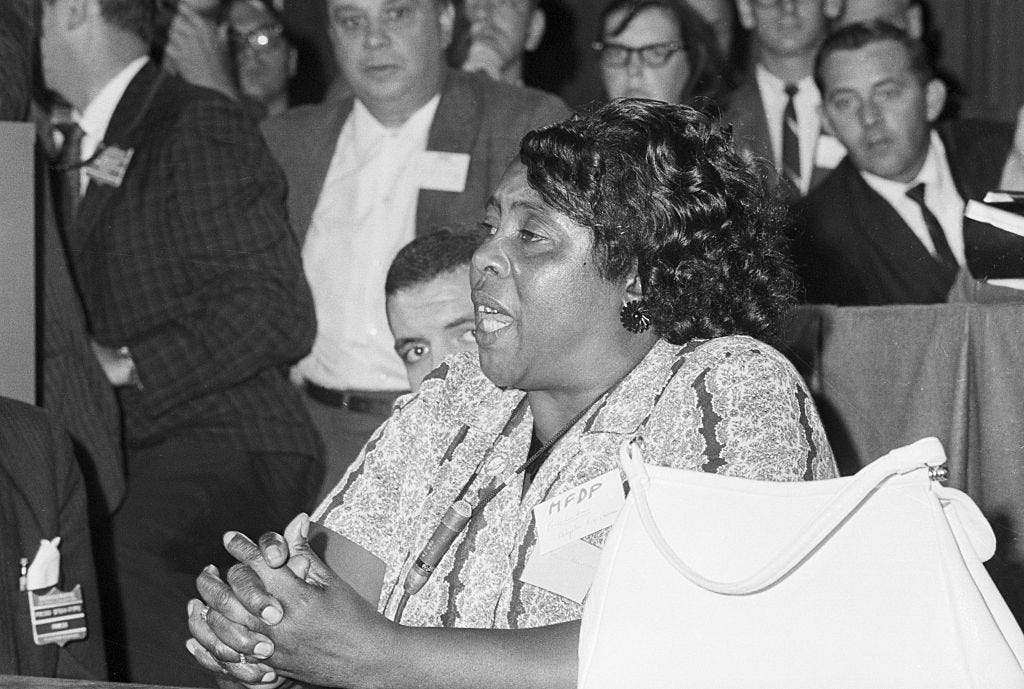
Fannie Lou Hamer, born in 1917 in Montgomery County, Mississippi (the twentieth child of a sharecropper family), registered to vote in 1962 at age forty-four. The registration ended her sharecropping employment within hours; the plantation owner who had employed her family for eighteen years gave her the choice between withdrawing her registration and leaving.
She left.
She joined the Student Nonviolent Coordinating Committee as a field secretary. On June 9, 1963, she was arrested with other SNCC organizers in Winona, Mississippi, taken to the Montgomery County jail, and beaten by police and forced trustees for hours. She had permanent kidney damage and a damaged eye from the assault. She was forty-six. The kidney damage contributed to her death in 1977.
On August 22, 1964, Hamer testified before the Credentials Committee of the Democratic National Convention in Atlantic City. The Mississippi Freedom Democratic Party (the integrated alternative to the all-white Mississippi delegation) was petitioning to be seated. Hamer’s testimony recounted, in detail, the Winona beating and the broader pattern of voter-suppression violence in the state.
President Lyndon Johnson, watching from the White House, called an emergency press conference in real time to pull the network television cameras off her. Network coverage of the testimony was cut mid-sentence. The networks aired Hamer’s testimony in full later that evening. The cutaway had not worked.
The Mississippi Freedom Democratic Party was not seated, but the institutional precedent for an all-white Southern delegation had been broken; by 1968, the Democratic National Convention required integrated delegations from all states.
A single forty-six-year-old Black woman, beaten in a Mississippi jail the year before, made a sitting President of the United States interrupt his own party’s convention coverage in an attempt to keep her testimony off the air, and lost. The testimony ran. The rules changed.
Moral courage operationalized at the scale of national party politics. The moral-courage-at-scale criterion the existing canon claims to honor when it honors Patrick Henry or Nathan Hale. By that criterion, Hamer is a Founder.
Lewis and Rustin.
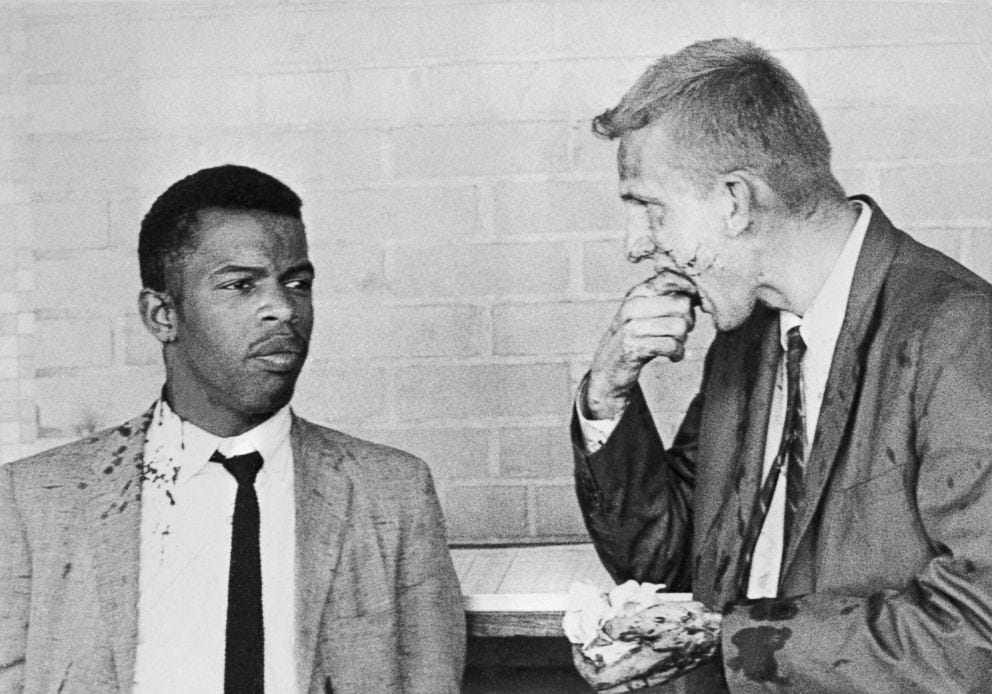
John Lewis was twenty-five years old on March 7, 1965, when he led the first of the three Selma-to-Montgomery marches across the Edmund Pettus Bridge. The Alabama State Troopers waiting on the bridge’s far side beat the marchers with billy clubs and tear-gassed the crowd. Lewis’s skull was fractured by a trooper.
The footage of the attack, Bloody Sunday, appeared on national television within hours and was a precipitating factor in the introduction of the Voting Rights Act of 1965 ten days later.
Lewis served in the U.S. House from 1987 to 2020 and was called, near the end of his life, the conscience of the Congress. He died on July 17, 2020.
The bridge on which his skull had been fractured remains named for Edmund Pettus, a Confederate brigadier general and a Grand Dragon of the Alabama Klan. The bill that bears Lewis’s name and would restore the federal preclearance regime gutted in Shelby County v. Holder has been filibustered four times.
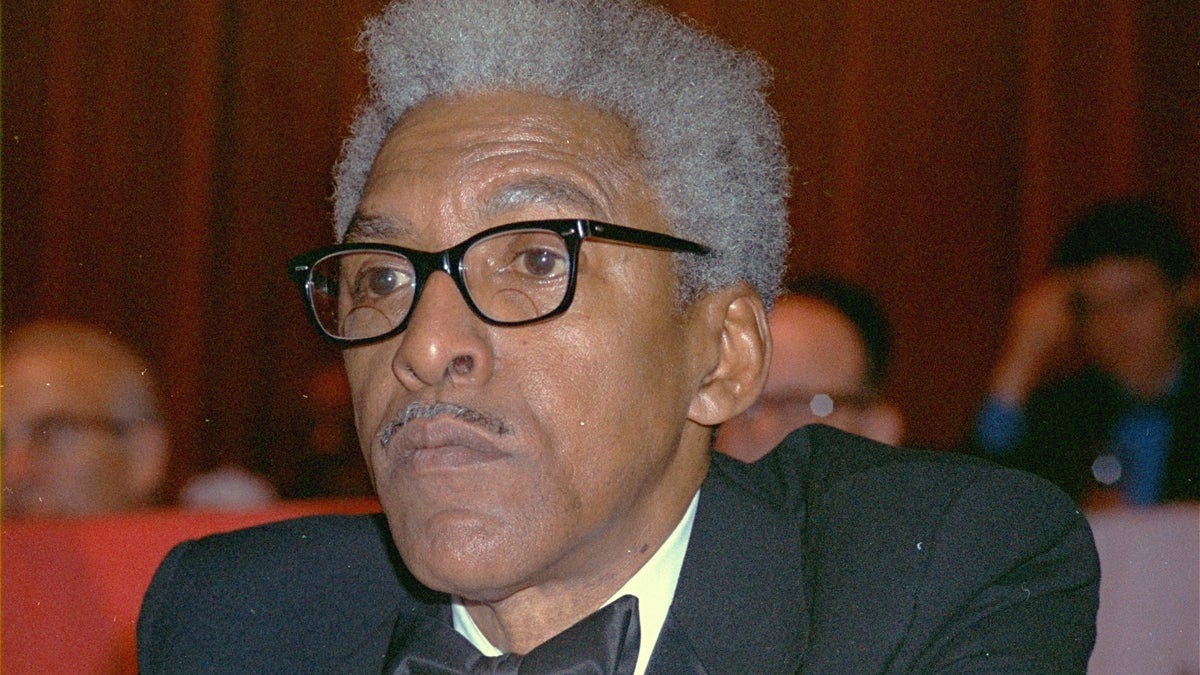
Bayard Rustin organized the operational architecture of the August 28, 1963 March on Washington.
Rustin’s responsibility was the operational logistics (buses, trains, sanitation, food, sound systems, speaker order, security, press, the legal apparatus around demonstration permits and First Amendment protection) across a sixty-day execution window for a quarter-million-person event. The march ran cleanly. King delivered “I Have a Dream” on a stage built and staffed by Rustin’s operation.
Rustin had been an early organizer of the Congress of Racial Equality, a Freedom Rider before there were Freedom Rides, and a strategic adviser to King from 1956 onward. He was also openly gay, in the political idiom of mid-century American public life (meaning known to be gay in ways that made his political enemies confident they could destroy him with the disclosure), and a former member of the Young Communist League.
The movement protected him by keeping him operationally central and publicly invisible.
The discipline that is required here, by the argumentative-political tradition that this pamphlet operates inside, is to look at the protection-by-invisibility as the canon-editing it actually was, not external to the movement but internal to it.
On August 13, 1963 (fifteen days before the march), Senator Strom Thurmond, a South Carolina segregationist Democrat, delivered a Senate floor speech denouncing Rustin as a homosexual, a draft dodger, and a former Communist; he placed Rustin’s complete arrest record into the Congressional Record on page 14836 and displayed FBI photographs.
The movement’s response, led by A. Philip Randolph, was a public unified-defense press conference: Randolph declared “complete confidence” in Rustin, refused to entertain any of Thurmond’s framing, and kept Rustin in his organizational role. The march ran. The defense had worked.
The movement’s response on the broader question (Rustin’s general public role across his career) was different.
Rustin remained backstage operationally, deliberately, for the rest of the movement’s central decade. He did not get the canonical recognition his role earned. The first major rehabilitation efforts came only in the 2000s, by activists and historians who recognized that the movement’s protection of him by invisibility had been, on its own logic, a kind of refusal: a refusal to claim publicly that a gay Black former Communist had been the indispensable operational architect of the most successful mass demonstration in American political history.
The canon-revision work is therefore not only about what the country at large has refused. It is also about what the movement itself, sometimes for defensible tactical reasons in the moment, refused to claim about its own composition.
Lewis’s original 1963 March on Washington speech draft contained material that A. Philip Randolph and other organizers asked him to revise: references to a civil rights bill that was “too little and too late,” a line about marching through the heart of Dixie “the way Sherman did,” a reference to “the revolution” being completed without further qualification. Lewis revised the speech the night before; the delivered version softened each line.
The “I Have a Dream” speech we remember was edited by its own movement in real time for political reasons that were not unreasonable in the moment and that did, materially, edit the canon.
The Rustin invisibility and the Lewis redaction are the same logic operating in different registers.
This is the part of canon revision the affirmative project cannot honestly skip. The work is not only the work of raising figures the country has refused. It is also the work of acknowledging what the movements that raised those figures refused, sometimes for understandable tactical reasons and sometimes not.
Honoring the canon we have earned means honoring its actual composition, which includes a gay Black former Communist who built the logistics of the March on Washington and a twenty-three-year-old future congressman whose first draft of his speech was more radical than the country was willing to hear from him.
That is the canon. Tubman, Wells, Houston, Marshall, Hamer, Lewis, Rustin. And the Reconstruction figures they extend out of: Revels, Bruce, Pinchback, Elliott, Lynch, White. Douglass anchoring it. The named victims of Wilmington 1898 not separated from the political-architectural figures but understood as part of the same canon, because the canon names both who built the second founding and who paid for it.
By every criterion the existing American canon claims to operate by, every name above belongs.
The country has the documentary record. It has had the documentary record for a century or more. What it has not done is build the monuments, write the textbook chapters, install the figures in marble at the front of the Capitol, and pass them through the curriculum into the next generation’s civic imagination.
The canon we have earned has been earned. It has not been raised.
Part VI — First Act
The work has begun.

In 2009, the Helen Keller statue replaced the Confederate officer Jabez Curry as Alabama’s second representative in U.S. Capitol Statuary Hall.
In 2022, the Mary McLeod Bethune statue replaced the Confederate general Edmund Kirby Smith as Florida’s second.
In 2024, Barbara Rose Johns (the sixteen-year-old who in 1951 led the student strike at the segregated Robert R. Moton High School in Farmville, Virginia, the strike that became part of the legal case consolidated into Brown v. Board) replaced Robert E. Lee as Virginia’s second.
Daisy Bates and Johnny Cash replaced two Arkansas figures including former senator James Paul Clarke, who had campaigned on an explicit white-supremacy platform.
The John Lewis statue went up in Decatur, Georgia in August 2024, on the site where a 1908 United Daughters of the Confederacy obelisk had stood; the obelisk was removed in 2020.
North Carolina’s slot, which had been held by Charles Brantley Aycock (one of the architects of the Wilmington 1898 coup), was emptied in 2024 and filled with Billy Graham, a choice the state legislature made over alternatives that would have placed in marble a Wilmington 1898 figure, or Hiram Revels who was born in Fayetteville, or Frederick Douglass.
The pace is slow. The scale is small.
From 2015 through the SPLC’s April 2025 Whose Heritage? report, 415 Confederate memorials have been removed, relocated, or renamed across the country. The pace accelerated sharply after the murder of George Floyd in May 2020. Against those 415 stand more than two thousand Confederate symbols still in American public space, including roughly 685 freestanding monuments.
The Wilmington 1898 Memorial Park has been dedicated since November 8, 2008. The Wilmington 1898 Museum for Healing, Education, and Democracy is planned to open in spring 2028, the 130th anniversary of the coup.
The first federal anti-lynching law was signed 130 years after Ida B. Wells began documenting lynchings. The Tubman $20 has been delayed six years past its 2020 target. The John R. Lewis Voting Rights Advancement Act has been filibustered four times.
This is what mythological correction looks like in real time. It is generational. It is local. It is constantly being resisted by people whose political coalition was built by the existing canon. It happens anyway.
Joshua Halsey was buried 123 years after his murder, in the season the Richmond Lee monument came down and the Lewis Act was filibustered. The work of the second founding has been waiting 150 years to be canonized. The work of canonizing it has been waiting for the political will to scale.
There is one passage that should anchor everything that follows from here.
In 1876, Frederick Douglass (fifty-eight years old, thirty-eight years out of slavery, eleven years into the legal freedom of Black Americans, twenty-five years past his break with Garrison, the year he delivered the Freedmen’s Memorial oration in front of Thomas Ball’s kneeling-figure bronze) wrote, separately from the oration, that no one monument could be made to tell the whole truth about emancipation. He continued: What I want to see before I die is a monument representing the negro, not couchant on his knees like a four-footed animal, but erect on his feet like a man.
He died nineteen years later. The monument he had asked for was not built.
The figures who carried his argument forward (Wells, Houston, Marshall, Hamer, Lewis, Rustin) also died, and the monuments they had earned were also not built. The figures who had built the second founding before him, alongside whom he had argued (Revels, Bruce, Elliott, White), also died, and the monuments they had earned were also not built.
The names of Wilmington’s dead were lost for a century. Joshua Halsey’s funeral required 123 years of his descendants’ work to bring about.
The country has had the witness for 150 years.
What we have not done is build at the scale the documentary record warrants. Tubman in marble at the Capitol. Wells in marble at the Capitol. Douglass not as a kneeling figure beside Lincoln but as the antislavery constitutional theorist who made the legal-operational form of the war amendments thinkable: erect on his feet like a man. Marshall not only on a Court bench but on the country’s currency. Hamer in fifth-grade textbooks alongside Patrick Henry. The Reconstruction officeholders restored to the years from which they have been erased. Wilmington taught with the same fluency that Lexington and Concord are taught. The named martyrs of the long American second founding canonized as the dead of the country’s actual founding wars are canonized.
Build a different canon and you have built a different country.
Civic mythology is not infrastructure that supports the country. It is the country, in the only form the country exists in the lives of the people who live in it.
The Capitol’s marble is the country. The textbook chapter is the country. The classroom anniversary is the country. The currency portrait is the country.
To change them is to change the country. To leave them is to leave the country what the existing canon has made it.
This pamphlet is not the work. The work is the building. The building is underway (locally, slowly, against organized resistance), and the question the moment puts in front of the country is whether the building scales.
The figures the canon has refused told us what they wanted built. They told us 150 years ago. They told us in their own words and on the public record and in the legal-historical documents the country has continuously had access to.
We have the witness. We have the documentary record. We have the operational instances already underway, at Statuary Hall, in Decatur, in Wilmington.
What we have not done is the harder discipline. We have not raised the figures who have been refused, at the scale the documentary record warrants, in the marble and the textbook and the curriculum and the currency and the anniversary of the country.
This is the first act of doing it.
Erect on his feet like a man.